
12.2.2Can I determine the interval without technology?
Interval of Convergence Analytically
INTERVAL OF CONVERGENCE WITHOUT A CALCULATOR

Copy Julien’s table and fill in any cells that you can, without a calculator. Are there any values that do not exist? If so, write DNE.
Without a calculator, Julien stops working and starts daydreaming about his homework from the night before. He remembers problem 12-70 where he found that
is the Maclaurin series for . Then he has an idea! He conjectures:
“Since
has a domain of , and since the Maclaurin series, , is centered at , then the radius of convergence of is .”
Since a Taylor series is a type of power series, use the Ratio Test to determine the radius of convergence. Was Julien’s conjecture correct? Why does this make sense?Use the radius of convergence to state the interval of convergence of
. Be sure to consider whether each endpoint should or should not be included. Justify your decision by stating which test you used to determine if each endpoint causes the series to converge or diverge. Use
to write a second-degree Maclaurin polynomial, . Then use it to approximate the values of and and add them to the table. Explain why
cannot be used to approximate .
In problem 12-66 from Lesson 12.2.1, you used technology to determine the interval of convergence for Maclaurin series of the following functions.
Use the Ratio Test to confirm those intervals.
Use term-by-term substitution to convert the first four terms and the general term of the Maclaurin series from part (a) into new series for each of the composite functions shown below. Then determine the interval of convergence for each series.
Can term-by-term substitution change the interval of convergence? Compare the results from parts (a) and (b) to justify your answer. For example, does the Maclaurin series for
have the same interval of convergence as the Maclaurin series for ?
Term-by-term substitution can affect the interval of convergence of a Taylor series. But what about term-by-term differentiation? Or term-by-term integration?
Make a prediction. Will differentiating (or antidifferentiating) a Taylor series affect its interval of convergence? In other words, would differentiation (or antidifferentiating) affect the outcome of the Ratio Test?
In order to test your prediction, consider the function
, whose derivatives exist for all orders. It is known that the first three terms and the general term of the
th-degree Taylor polynomial, , centered at is:
Use sigma notation to write theth-degree Taylor polynomial above as a Taylor series, centered at . Then use the Ratio Test to determine the radius of convergence. Use term-by-term differentiation and term-by-term integration to write the first three terms and the general term of the
th-degree Taylor polynomial centered at for and . Use sigma notation to write each of the
th-degree Taylor polynomials in part (ii) as a Taylor series, centered at , for and . Then use the Ratio Test to determine the radius of convergence of each series.
How does the radius of convergence of the Taylor series for
centered at compare to the radii of convergence for the Taylor series found by term-by-term differentiation or term-by-term antidifferentiation? Does this confirm or contradict your prediction in part (a)? What is the interval of convergence for
, , and centered at ?
A GENERAL CASE
The Math Notes box in Lesson 12.1.4 defined the first four terms and the general term of a Taylor series centered at
This can also be expressed as:
where
Using
to represent the coefficient of each term, apply the Ratio Test to the general Taylor series shown above and determine its radius of convergence in terms of . Interpret your result from part (a). For any Taylor series, what does the radius of convergence depend upon?
Now differentiate each term of the Taylor polynomial for
. Write the first three terms and the general term of the Taylor polynomial for centered at . Then determine the radius of convergence of the corresponding Taylor series. Now integrate each term of the Taylor polynomial for
centered at to write a Taylor series for . Then determine the radius of convergence. Summarize your results. If you know the radius of convergence of a Taylor series for a function
, how can you determine the radius of convergence of the Taylor series found by term-by-term differentiation or term-by-term integration? Does this work for term-by-term substitution as well? Determine the radius of convergence of the Maclaurin series for
. Explain how you obtained this radius. Hint: is the derivative of from part (b) of problem

Examine the integral
Explain why this integral cannot be evaluated exactly.
Estimate
, using a Riemann sum with five left endpoint rectangles. Use substitution and the sixth-degree Maclaurin polynomial for
to get an approximation of . Estimate
using your polynomial from part (c). How can you improve your answers to parts (b) and (d)?
There are

Let
represent the number of groundhogs who have fleas after days. Write a differential equation that models the spread of the fleas. Write a general solution to the differential equation.
Recall that
when because four groundhogs were initially infected. Suppose that after ten days, groundhogs have fleas. Write an equation for in terms of .
Write the derivative with respect to
, is a constant
, is a constant
Consider the graph of
Multiple Choice: Without a calculator, determine the area of the region in the second and third quadrants bounded by the polar curve
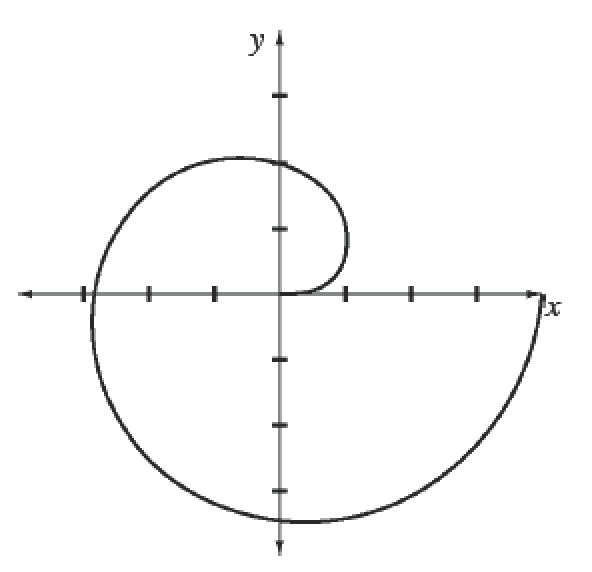
Multiple Choice: Which of the following statements must be true about the function defined at right? Homework Help ✎
is continuous at . is differentiable at . is differentiable at .
I only
II only
I and III only
II and III only
I and II only
Multiple Choice: Which of the following limits equals
I
III
I, III
I, II, III
I, II
For the parametric curve with equations
horizontal
vertical


